
“禪,” pronounced as “Zen,” represents a profound meditative practice centered on direct experience and awareness. It originated from the fusion of Mahayana Buddhism and Taoist thought, emphasizing personal insight over theoretical knowledge. In Zen, you explore concepts like Buddha-nature and emptiness, recognizing your potential for enlightenment and the interconnectedness of all beings. This path transforms everyday moments into profound experiences. There’s so much more to discover about how Zen can shape your life.
The Etymology of Zen
The term “Zen” has a rich history that traces back to ancient languages. It derives from the Japanese pronunciation of the Middle Chinese word 禪 (chán), which is a transliteration of the Sanskrit term dhyāna, meaning contemplation or meditative state.
Zen originated in China during the Tang dynasty as the Chan School, merging Indian Mahayana Buddhism with Chinese Taoist thought. This blend emphasizes direct insight and personal experience, inviting you to move beyond theoretical understanding.
The goal is to realize your own Buddha nature, awakening a profound awareness within. In contemporary language, “zen” often conveys a peaceful state of mind, reflecting the essence of meditation and tranquility. Engaging in self-reflection can deepen your understanding of Zen principles and enhance your meditative practice.
Zen’s evolution highlights its significance in both historical and modern contexts.
Core Principles of Zen Practice
While engaging in Zen practice, you’ll discover that its core principles revolve around direct experience and personal insight. The foundational method is zazen, or sitting meditation, which helps you attain a deeper understanding of your own Buddha nature and the true nature of reality.
You’ll also encounter the concept of “no-mind,” encouraging you to transcend dualistic thinking and remain aware without distractions. Zen rituals and ceremonies enhance your meditation practice, fostering gratitude and community among fellow practitioners.
Additionally, you’ll find that the bodhisattva path is integral, promoting virtues like compassion and wisdom for the benefit of all beings.
Finally, Zen teachings advocate integrating mindfulness into daily activities, reflecting the essence of your Zen practice and enhancing your overall life experience. Practicing self-approval can further enrich your Zen journey by fostering unconditional self-acceptance and emotional well-being.
Meditation Techniques in Zen
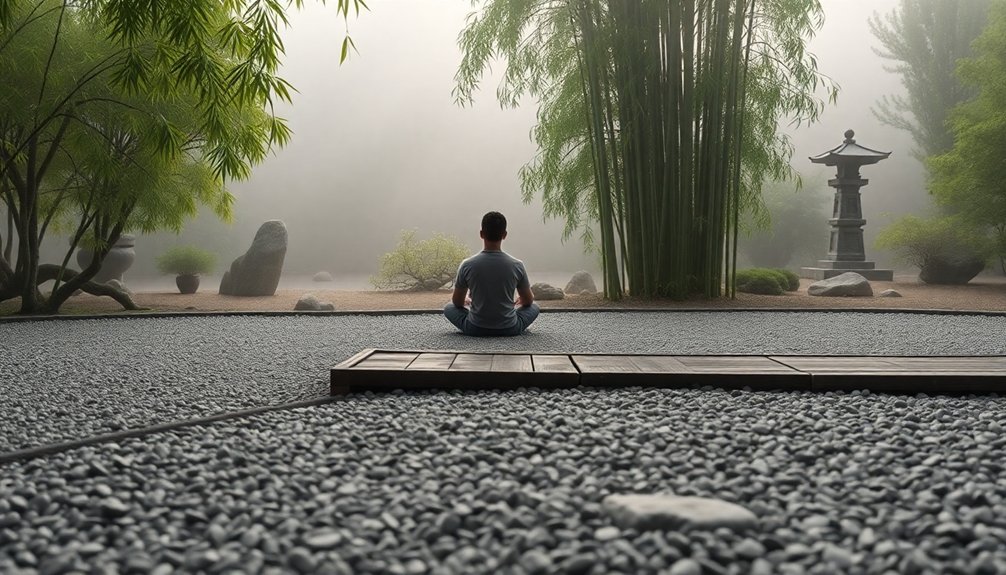
How can you deepen your Zen practice through meditation techniques? One fundamental method is zazen, or sitting meditation, where you focus on objectless sitting in silence. This helps you cultivate awareness and connect with ultimate reality.
Zen masters often emphasize proper posture, such as lotus or half-lotus, to maintain stability and alertness during your sessions. In Soto Zen, shikantaza, or “just sitting,” encourages you to experience reality directly, free from ego interference.
Alternatively, the Rinzai school uses the kan method, challenging you with koans to transcend intellectual thought. Incorporating breathing techniques is essential, too; you can enhance your concentration by simply counting breaths, allowing each inhale and exhale to ground you in the present moment. Additionally, integrating yoga and mindfulness practices can complement your meditation routine by fostering inner balance and mental clarity.
Understanding Buddha-nature
To grasp Buddha-nature, you need to recognize that the potential for enlightenment is already within you. This understanding isn’t just theoretical; it should manifest in your daily life through compassion and wisdom. Embracing radical self-acceptance allows you to fully acknowledge your intrinsic worth and cultivate a deeper connection with your true self.
Essence of Buddha-nature
Understanding Buddha-nature reveals the innate potential for enlightenment that exists within every being. This concept emphasizes that you have the ability to realize your true nature, a realization that’s at the heart of Zen practice.
Through Zen meditation, or zazen, you can access this immediate reality, transcending the ordinary notions of selfhood. Recognizing your Buddha-nature means embracing the non-dual relationship between yourself and reality, which encourages you to let go of attachments and dualistic thinking.
As you deepen your practice, you embody wisdom and compassion, transforming how you interact with the world. Ultimately, grasping the essence of Buddha-nature empowers you to see existence holistically, revealing the interconnectedness of all beings in this journey toward enlightenment.
Manifesting in Daily Life
Recognizing your Buddha-nature isn’t just a theoretical concept; it’s something that can be actively manifested in your daily life.
By cultivating mindfulness in every moment, you train your mind to notice the beauty in ordinary tasks. When you engage in the practice of zazen, you create space to experience your true nature, dissolving the barriers between yourself and others.
This awareness transforms mundane activities into opportunities for enlightenment, allowing you to express compassion and responsibility. As you incorporate the bodhisattva precepts into your daily life, you foster harmonious relationships, not just with yourself, but with the world around you.
Embrace each action as a chance to reveal the inherent potential for enlightenment that resides within you.
The Concept of Emptiness

Emptiness, a profound aspect of Zen philosophy, reveals that nothing possesses an inherent, unchanging essence. In Zen Buddhism, this concept encourages you to see the interconnectedness of all things, transcending dualistic thinking.
As you engage in the practice of meditation, the realization of emptiness allows you to let go of attachments and ego, leading to a deeper understanding of your true nature. This journey of self-discovery resonates with the principles of quiet confidence, which emphasizes internal assurance over external validation.
Imagine:
- A vast sky, unbounded and limitless.
- A flowing river, constantly changing yet always itself.
- A whispering breeze, connecting everything it touches.
Embracing emptiness isn’t nihilism; it fosters compassion and wisdom, as recognizing the emptiness of self and other nurtures a sense of unity with all existence.
The Role of Rituals and Chanting
Rituals and chanting play an essential role in Zen practice, enriching your meditation experience and fostering a strong sense of community.
In Zen monasteries, ceremonies like the Fusatsu Ceremony focus on atonement, while mealtime rituals express gratitude and interdependence. You’ll often find that chanting the verses and sutras deepens your mindfulness, transforming ordinary activities into moments of enlightenment.
Meditation manuals guide you through these practices, emphasizing their importance in cultivating awareness and connection.
Whether you’re in a temple or dojo, these rituals create a shared space where practitioners harmonize their energies, reinforcing the communal aspect of Zen.
Through these acts, you can experience freedom of mind and a deeper understanding of your place in the world. Engaging in volunteering and community involvement allows you to connect with others who share similar values, enhancing the sense of belonging within the Zen community.
Zen and Non-duality
While exploring Zen, you’ll find that non-duality is a central theme that challenges conventional ways of thinking.
Exploring Zen unveils non-duality, inviting you to transcend conventional thinking and embrace a unified existence.
This perspective, often encapsulated in the phrase “not one and not two,” invites you to transcend dualistic distinctions.
A Zen master might guide you toward a state of mind where:
- The boundary between self and other blurs like morning mist.
- Experiences are felt deeply, without the need to categorize them.
- You find unity in the complexity of existence, embracing the world as it is.
Practicing mindfulness techniques can further enhance your connection to this non-dual awareness.
The Journey Toward Enlightenment
As you explore Zen meditation practices, you’ll discover how they guide you toward enlightenment. Insights from koan training can challenge your thinking and help you overcome dualistic perspectives. Embracing these experiences allows you to connect with your true nature and cultivate wisdom for yourself and others. Developing emotional resilience can enhance your journey toward inner peace and self-discovery.
Zen Meditation Practices
Zen meditation practices, particularly zazen, invite you to step into a space of silence and presence, allowing you to directly encounter the true nature of reality.
As you engage in the practice of sitting, focus on your breath and the sensations in your body. This method, rooted in Japanese Rinzai tradition, emphasizes just being without thought interference.
- Feel the weight of your body grounding you in the moment.
- Notice the gentle rise and fall of your breath, anchoring your awareness.
- Embrace the clarity that arises from sustained concentration.
Through regular practice, especially within a sangha, you cultivate wisdom and compassion, deepening your journey toward enlightenment.
Insights From Koan Training
Engaging with koan training opens a doorway to profound insights that challenge your understanding of reality.
As you explore paradoxical kōans, you provoke deep thinking that transcends rationality. The Rinzai school of Zen Buddhism, with its emphasis on the kan method, categorizes about 1,700 formal cases designed to guide you toward enlightenment.
Through meditation and dialogue with a Zen master, you investigate the essence of each kōan, fostering direct experiential understanding. The goal isn’t just intellectual analysis; it’s about embodying the kōan, leading to spontaneous experiences of enlightenment.
Successfully resolving a kōan often results in a significant shift in perception, deepening your understanding of your true nature and the nature of reality itself.
Overcoming Dualistic Thinking
While many people perceive the world in binary terms, overcoming dualistic thinking is essential for your journey toward enlightenment. Zen teaches that embracing a non-dual relationship helps you move beyond the confines of self and other, allowing you to experience life more fully.
- Imagine a serene landscape where sky meets earth, blurring boundaries.
- Picture a flowing river, merging water and stone without distinction.
- Visualize a dance where partners become one, transcending individual identities.
As you let go of attachments that create psychological distance, you’ll uncover your true nature.
This third perspective, free from dualism, fosters wisdom and compassion in everyday life, guiding you toward deeper understanding and connection.
Zen’s Influence on Daily Life
Incorporating Zen principles into your daily life can transform ordinary moments into profound experiences. By practicing mindfulness, you embrace the present, allowing both joys and sorrows to enrich your journey.
Engaging in a daily Zen practice means turning activities like eating and walking into opportunities for meditation, fostering awareness in every moment. The Japanese concept of simplicity encourages you to cultivate gratitude and respect for your surroundings, leading to a more peaceful emotional state.
Zen rituals, such as mealtime practices, create a sense of interconnectedness, reminding you of your bond with others. By embracing the bodhisattva precepts, you take responsibility for your actions, positively impacting your community and enhancing your overall well-being. Additionally, incorporating mindfulness practices can further enhance your present-moment awareness and emotional well-being.
Conclusion
In exploring “禪,” you’ve uncovered a rich tapestry woven with mindfulness, emptiness, and the pursuit of enlightenment. Just as a tranquil pond reflects the sky, Zen invites you to look within and discover your true nature. As you embrace these principles, you’ll find that each moment becomes a brushstroke on the canvas of your life, painting a picture of clarity and peace. So, step into this journey and let Zen transform your everyday existence into something extraordinary.